History of the Guna Yala: Origins and Migrations
The Guna, also known as Kuna until a few years ago, are originally from the region of Darien, located between Panama and Colombia. It is estimated that their presence in the area dates back at least to hace 500 años, although some historians suggest that they may have inhabited the region since pre-Columbian times.
Migrations and settlement in San Blas in the history of the Guna Yala
The history of the Guna Yala is marked by migration, adaptation, and resistance. Although the Guna are closely associated with the San Blas Archipelago today, their story begins in a very different setting: the continent, in the region of Darien, between what is now Panama and Colombia.
The decision to move to the islands was the result of a long process of forced displacement and adaptation, driven by conflicts with other tribes, the arrival of European colonizers and the need to find a safe territory where they could develop their culture without external threats.
1. Continental origin and first migrations (13th – 15th centuries)
Archaeological and linguistic studies suggest that the Guna were part of a larger indigenous group inhabiting the Darien forests. For centuries, these communities lived in small agricultural settlements, practicing an economy based on fishing, hunting, and the cultivation of corn, cassava, and beans.
However, around the thirteenth century, began to be produced migration movements within the isthmus due to several factors:
✔️ Expansion of other indigenous groups, such as the Emberá and the Wounaan, who began to occupy traditionally Guna territories.
✔️ Lack of sources, which led small clans to move in search of better lands.
✔️ Rise of intertribal trade, which favored the establishment of communities closer to the coasts to facilitate the exchange of products.
It is believed that during this period, some Guna groups had already begun to temporarily settle on coastal islands as a refuge from the conflicts in the interior of Darien.
2. Impact of European colonization and mass displacement (16th-17th centuries)
The arrival of Spaniards in the 16th century It marked a turning point for the Guna. Colonization brought with it violence, disease, and exploitation, severely impacting many indigenous tribes in the region.
Unlike other groups that were completely subdued or exterminated, the Guna managed to resist the Spanish occupation thanks to several strategies:
✔️ War and armed resistanceThe Guna were involved in several confrontations against the conquerors, attacking colonial outposts and avoiding direct submission.
✔️ Strategic alliancesThey allied themselves with English and French privateers and pirates, who were also fighting against the Spanish in the Caribbean.
✔️ Territorial mobilityInstead of submitting, the Guna chose to relocate to areas less accessible to colonizers.
It was in this context that, in the middle of the seventeenth century, a large part of the Guna population began to move definitely to the islands of the San Blas Archipelagowhere they could better protect themselves from Spanish attacks and attacks from other enemy tribes.
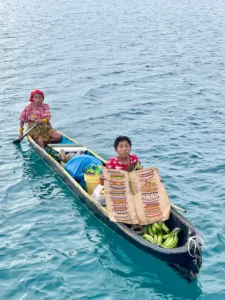
In this migration, the Guna mostly abandoned the extensive agriculture of the continent and adapted to a maritime economy, based on fishing, mollusc gathering and coconut trade with European vessels.
3. Adaptation to the island environment and consolidation in San Blas (18th – 19th centuries)
Upon arriving in the San Blas Archipelago, the Guna faced new challenges. Moving from a life in the jungle to an island life required a radical change in their economic practices, their social organization, and their relationship with the environment.
✔️ Change in diet: They replaced extensive crops with Coconut farming and fishing as the main sources of livelihood.
✔️ Construction of homes adapted to the marine environmentThey began building houses on wooden stilts to withstand flooding and the humid climate.
✔️ Development of maritime trade routesThey established trade with European and Colombian ships, exchanging products such as coconuts, salt, dried fish, and handicrafts for tools, fabrics, and weapons.
✔️ Creating a traditional navigation systemThey learned to navigate canoes with sails and oars, which allowed them to move easily between islands and the mainland.
On eighteenth century, the Guna presence in San Blas had been fully consolidated. The island communities grew in number and began to organize into clans led by the sailas, who had both political and spiritual functions.
For nineteenth century, the Guna had already established a network of autonomous communities in more than 49 islands, maintaining contact with each other through community conferences and marriage alliances between different islands.
4. Relations with the Panamanian State and the reaffirmation of its territory (20th century)
When Panama became independent from Colombia in 1903, the Guna were faced with a new challenge: the Panamanian government attempted to assimilate them into the national culture, imposing rules that threatened their customs and their system of self-government.
✔️ Prohibition of their traditional clothing and spiritual rituals.
✔️ Attempt to establish Panamanian schools to replace traditional Guna education.
✔️ Police occupation of the islands to enforce Panamanian law.
Given this situation, which seriously jeopardized the preservation of the Guna cultureThe people rose up in arms during the Tule Revolution of 1925. As a result of this conflict, the Panamanian State ended up recognizing their right to self-determination and, years later, in 1938, officially recognized the creation of the Guna Yala Regionthus guaranteeing their territorial and cultural autonomy.
Since then, the Guna have maintained strict control over their islands, regulating the entry of foreigners and ensuring that any economic activity (including tourism) directly benefits the community.
Conclusion of the Guna Yala story: a people in constant adaptation
The Guna migration process was not simply a change of territory, but a profound transformation of their culture and way of life.
✔️ They moved from a system based on jungle agriculture to an island economy centered on the sea.
✔️ They became expert navigators and traders, establishing trade networks with Europeans and Colombians.
✔️ They resisted centuries of oppression, managing to consolidate an autonomous territory that persists to this day.
Despite current challenges, such as the climate change and the pressure of the , the Guna have demonstrated an incredible capacity to resistance and adaptation, keeping their traditions alive in a constantly changing world.
The Tule Revolution and Guna autonomy: a legacy of resistance
One of the most important events in the history of the Guna was the Tule Revolution of 1925, also known as the Guna Insurrection.
Causes of the uprising
At the beginning of the 20th century, the Panamanian government attempted to force the Guna into national society. The main causes of the rebellion were:
- Prohibition of their traditions, such as spiritual rituals and traditional clothing.
- Violent repression by the Panamanian police against indigenous leaders.
- Attempt to impose external schools and government structures.
Conflict development
✔️ February 4, 1925: led by Nele Kantule and Simral Colman, the Guna took up arms against the Panamanian police on several islands.
✔️ February 5, 1925: Guna independence is declared and government officials are expelled.
✔️ March 1925: Panama signs an agreement recognizing the autonomy of the Guna, which leads to the creation of the Guna Yala Region in 1938.
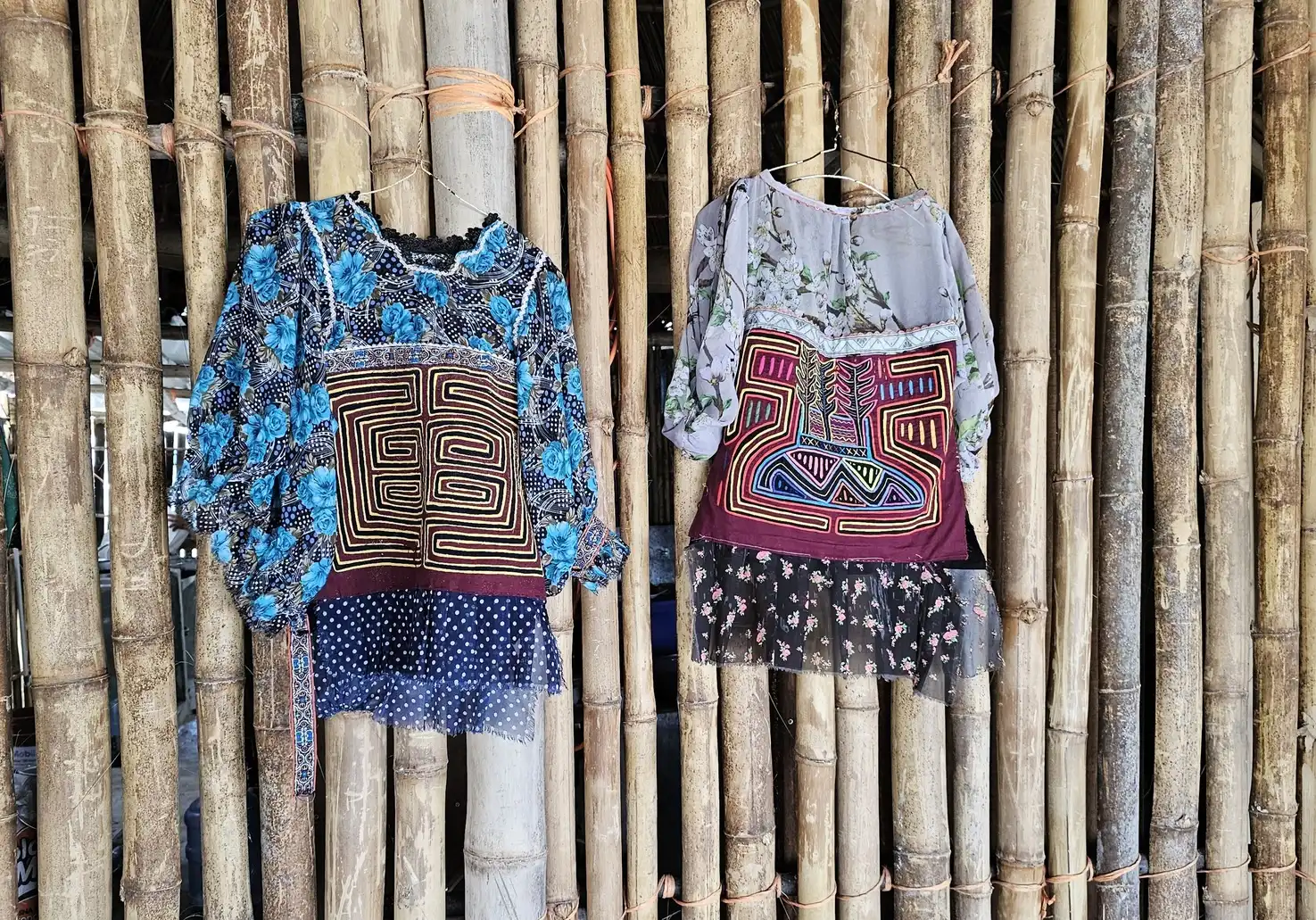
Consequences of the Tule Revolution in the history of the Guna Yala
Since then, the Guna have been one of the most autonomous indigenous peoples in Latin America, with its own system of government and control of its territory.
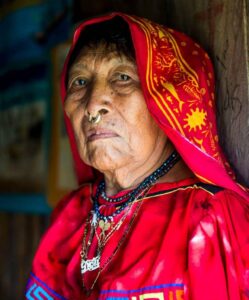
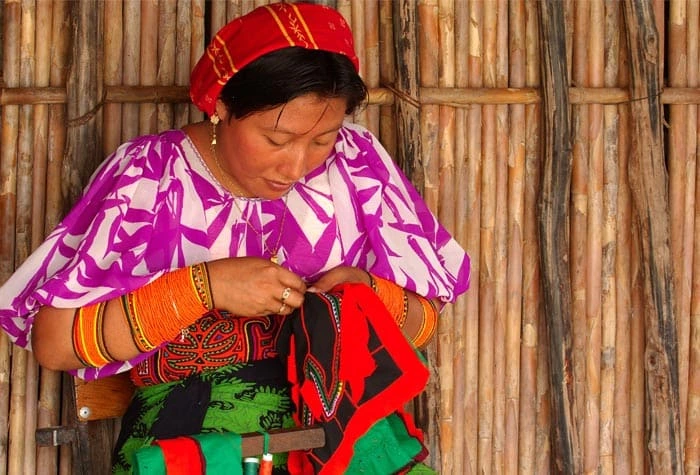
In short, the history of the Guna Yala is a testament to resilience and adaptation. From their origins in the Darién to their consolidation in the San Blas Islands, this people has demonstrated a unique ability to preserve their cultural identity in the face of constant challenges. Today the Guna woman They have a role fundamental in society, not only as mothers and caregivers, but also as economic leaders, guardians of culture and transmitters of ancestral knowledge.
Their legacy, marked by migration, resilience, and autonomy, is an inspiring example of how a community can keep its traditions alive over time. If you've been captivated by this journey through the history of the Guna Yala, I encourage you to explore other articles on our blog about this paradise in the Panamanian Caribbean.