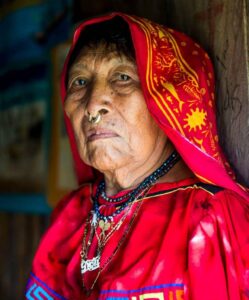
Guna Yala culture: Between Tradition and Modernity
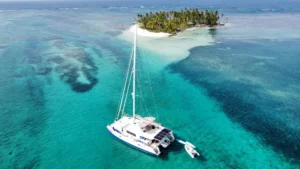
In the crystalline waters of the Panamanian Caribbean, 365 islands rise, guarding one of Latin America's best-preserved secrets. Here live the Guna Yala people, an indigenous community that has achieved something many consider impossible in the XNUMXst century: maintain its political and cultural autonomy intact in the face of the pressures of the modern world.
But behind this strength lies a complex reality. The Guna face two paradoxes that define their future: How can they continue to be guardians of ancient traditions when the ocean that protected them for centuries now threatens to wipe them off the map?
And at the same time, Is it possible that tourism, which has brought them economic prosperity, ends up destroying the very thing that visitors come to experience: their authentic culture?
The story you are about to discover is not only the chronicle of an extraordinary people, but the answer to these fundamental questions that will determine whether the Guna Yala can navigate the turbulent waters of the 21st century without losing the soul of their ancestral identity.

History of the Guna Yala: Origins and Migrations
The Guna, also known as Kuna until a few years ago, are originally from the region of Darien, located between Panama and Colombia.
It is estimated that their presence in the area dates back at least to hace 500 años, although some historians suggest that they may have inhabited the region since pre-Columbian times.
Migrations and settlement in San Blas
The history of the Guna Yala is marked by migration, adaptation, and resistance. Although the Guna are closely associated with the San Blas Archipelago today, their story begins in a very different setting: the continent, in the region of Darien, between what is now Panama and Colombia.
The decision to move to the islands was the result of a long process of forced displacement and adaptation, driven by conflicts with other tribes, the arrival of European colonizers and the need to find a safe territory where they could develop their culture without external threats.
1. Continental origin and first migrations (XNUMXth – XNUMXth century).
Archaeological and linguistic studies suggest that the Guna were part of a larger indigenous group inhabiting the Darien forests. For centuries, these communities lived in small agricultural settlements, practicing an economy based on fishing, hunting, and the cultivation of corn, cassava, and beans.
However, around the thirteenth century, began to be produced migration movements within the isthmus due to several factors:
✔️ Expansion of other indigenous groups, such as the Emberá and the Wounaan, who began to occupy traditionally Guna territories.
✔️ Lack of sources, which led small clans to move in search of better lands.
✔️ Rise of intertribal trade, which favored the establishment of communities closer to the coasts to facilitate the exchange of products.
It is believed that during this period, some Guna groups had already begun to temporarily settle on coastal islands as a refuge from the conflicts in the interior of Darien.
2. Impact of European colonization and mass displacement (XNUMXth – XNUMXth century).
The arrival of Spaniards in the 16th century It marked a turning point for the Guna. Colonization brought with it violence, disease, and exploitation, severely impacting many indigenous tribes in the region.
Unlike other groups that were completely subdued or exterminated, the Guna managed to resist the Spanish occupation thanks to several strategies:
✔️ War and armed resistanceThe Guna were involved in several confrontations against the conquerors, attacking colonial outposts and avoiding direct submission.
✔️ Strategic alliancesThey allied themselves with English and French privateers and pirates, who were also fighting against the Spanish in the Caribbean.
✔️ Territorial mobilityInstead of submitting, the Guna chose to relocate to areas less accessible to colonizers.
It was in this context that, in the middle of the seventeenth century, a large part of the Guna population began to move definitely to the islands of the San Blas Archipelago, where they could better protect themselves from Spanish attacks andand other enemy tribes.
In this migration, the Guna mostly abandoned the extensive agriculture of the continent and adapted to a maritime economy, based on fishing, mollusc gathering and coconut trade with European vessels.
Adaptation to the island environment and consolidation in San Blas (18th – 19th century).
Upon arriving in the San Blas Archipelago, the Guna faced new challenges. Moving from a life in the jungle to an island life required a radical change in their economic practices, their social organization, and their relationship with the environment.
✔️ Change in diet: They replaced extensive crops with Coconut farming and fishing as the main sources of livelihood.
✔️ Construction of homes adapted to the marine environmentThey began building houses on wooden stilts to withstand flooding and the humid climate.
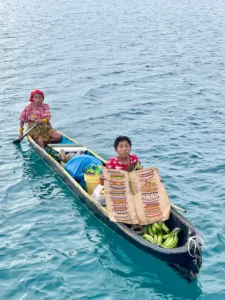
✔️ Development of maritime trade routesThey established trade with European and Colombian ships, exchanging products such as coconuts, salt, dried fish, and handicrafts for tools, fabrics, and weapons.
✔️ Creating a traditional navigation systemThey learned to navigate canoes with sails and oars, which allowed them to move easily between islands and the mainland.
On eighteenth century, the Guna presence in San Blas had been fully consolidated. The island communities grew in number and began to organize into clans led by the sailas, who had both political and spiritual functions.
For nineteenth century, the Guna had already established a network of autonomous communities in more than 49 islands, maintaining contact with each other through community conferences and marriage alliances between different islands.
4. Relations with the Panamanian State and the reaffirmation of its territory (XNUMXth century).
When Panama became independent from Colombia in 1903, the Guna were faced with a new challenge: the Panamanian government attempted to assimilate them into the national culture, imposing rules that threatened their customs and their system of self-government.
✔️ Prohibition of their traditional clothing and spiritual rituals.
✔️ Attempt to establish Panamanian schools to replace traditional Guna education.
✔️ Police occupation of the islands to enforce Panamanian law.
Faced with this situation, the Guna took up arms in the Tule Revolution of 1925, getting the Panamanian government to recognize its autonomy and the official existence of the Guna Yala Region in 1938.
Since then, the Guna have maintained strict control over their islands, regulating the entry of foreigners and ensuring that any economic activity (including tourism) directly benefits the community.
Conclusion: a people in constant adaptation
The Guna migration process was not simply a change of territory, but a profound transformation of their culture and way of life.
✔️ They moved from a system based on jungle agriculture to an island economy centered on the sea.
✔️ They became expert navigators and traders, establishing trade networks with Europeans and Colombians.
✔️ They resisted centuries of oppression, managing to consolidate an autonomous territory that persists to this day.
Despite current challenges, such as the climate change and the pressure of the , the Guna have demonstrated an incredible capacity to resistance and adaptation, keeping their traditions alive in a constantly changing world.
The Tule Revolution and Guna autonomy: a legacy of resistance
One of the most important events in the history of the Guna was the Tule Revolution of 1925, also known as the Guna Insurrection.
Causes of the Tule uprising
At the beginning of the 20th century, the Panamanian government attempted to force the Guna into national society. The main causes of the rebellion were:
- Prohibition of their traditions, such as spiritual rituals and traditional clothing.
- Violent repressionby the Panamanian police against indigenous leaders.
- Attempt to impose external schools and government structures.
Conflict development
✔️ February 4, 1925: led by Nele Kantule and Simral Colman, the Guna took up arms against the Panamanian police on several islands.
✔️ February 5, 1925: Guna independence is declared and government officials are expelled.
✔️ March 1925: Panama signs an agreement recognizing the autonomy of the Guna, which leads to the creation of the Guna Yala Region in 1938.
Consequences of the Tule Revolution
Since then, the Guna have been one of the most autonomous indigenous peoples in Latin America, with its own system of government and control of its territory.
Social and political structure: how the Guna Yala are governed
The Guna have developed over the centuries a autonomous political and social system, based on community decision-making, oral transmission of knowledge and deep respect for their traditional leaders.
Unlike Western models of government, where authority is concentrated in individuals or centralized institutions, the Guna practice a community democracy, in which the participation of the community is fundamental.
The central axis of this system is the Guna General Congress, an organization that regulates life in the region and protects its autonomy from the Panamanian government. In addition, each community has its own leadership system, headed by the sailas and neles, who not only govern, but also preserve the culture and traditions of the people.
1. Traditional political organization and its historical evolution.
The Guna government has gone through different stages of development, adapting to political changes in Panama and around the world.
✔️ Pre-Columbian era: There was a tribal organization, with spiritual leaders and warriors who made decisions in small clans scattered throughout Darien.
✔️ Colonial period: The need to defend themselves from the Spanish and other tribes led to the creation of a more structured leadership, with alliances between communities.
✔️ XIX century: The figure of the sail as supreme leader of each island, combining political and spiritual functions.
✔️ 1925th Century (XNUMX – Tule Revolution): The Guna General Congress, the body that coordinates the decisions of the region.
Since the Tule Revolution of 1925, the Guna have maintained their autonomy within Panama, resisting any attempt at State interference in its internal affairs.
2. The Sailas: Authority, functions and election.
El sail is the highest authority of each Guna community. His role is govern, advise and transmit ancestral wisdom through oral communication.
Functions of the saila
🔹 Guardian of tradition: He knows and transmits the sacred songs and the history of the people.
🔹 Judge and mediator: Resolves conflicts within the community without the need for physical punishment.
🔹 Political representative: Defends the interests of his community before the Guna General Congress and the Panamanian government.
🔹 Spiritual guide: Although not a shaman, the saila has a connection with the spirits and leads important ceremonies.
How to choose a saila
Saila is not imposed by force, but is chosen by consensus within the community.
✔️ The selection process can last months or even years.
✔️ An older man with in-depth knowledge of Guna culture and laws is selected.
✔️ Once chosen, he is accompanied by the Argar, who help him communicate with the community.
3. Guna General Congress: The heart of the autonomous government
El Guna General Congress is the highest political authority in the region and is responsible for regulate life on the islands, protect autonomy, and represent the Guna before the Panamanian State.
Structure of the Guna General Congress
✔️ Local congresses: Each island has its own congress, where decisions on community matters are made.
✔️ General Congress: It meets twice a year and is made up of representatives from all communities.
✔️ Secretaries and delegates: They are responsible for implementing the decisions of Congress and maintaining communication with the Panamanian government.
Main functions of Congress
🔹 Legislation: Create and modify the internal rules of the region.
🔹 Territorial defense: Manages land and sea use in San Blas.
🔹 Diplomatic relations: It is responsible for negotiating with the Panamanian government and international organizations.
🔹 Education and culture: Regulates the education system and promotes the teaching of the Dulegaya language.
The Guna General Congress is the body that has allowed the Guna to maintain their autonomy for more than a century, avoiding forced assimilation by the Panamanian state.
4. Internal rules and conflict resolution
The Guna have a own justice system, based on conciliation and respect for the community.
✔️ There are no prisons or corporal punishments.
✔️ Minor crimes (thefts, fights) are resolved with community service or social sanctions.
✔️ Family and cohabitation conflicts They are addressed in public meetings, where the community gives its opinion and seeks fair solutions.
✔️ Serious crimes, such as murder, are evaluated by the General Congress and can lead to expulsion from the community.
This justice system seeks restore social balance, instead of punishing offenders violently.
5. Relationship with the Panamanian State: autonomy and challenges
Since the creation of Guna Yala region in 1938The Guna have maintained almost total control over their territory. However, their relationship with the Panamanian government has not always been easy.
Conflicts with the State
✔️ Control of natural resources: The Panamanian government has attempted to exploit the marine and forest resources of San Blas, but the Guna have rejected these interventions.
✔️ Education: Panama has attempted to impose an external educational model, while the Guna insist on a bilingual system that preserves their culture.
✔️ Tourism: Although tourism generates income, the government has sought to regulate it in ways that would affect the Guna's control over their islands.
Despite these challenges, the Guna have managed maintain their autonomy thanks to its strong political organization and the unity of its communities.
Conclusion: A successful self-government model
The political system of the Guna is one of the most successful in Latin America, demonstrating that an indigenous community can govern itself effectively without relying on external structures.
✔️ Its participatory democratic model has allowed for collective decision-making.
✔️ Your restorative justice system maintains social peace without the need for repression.
✔️ The Guna General Congress has been key to resisting pressure from the Panamanian government.
Today, the Guna continue to face challenges, such as climate change and the influence of the modern world. However, their system of government has allowed them to adapt to changes without losing their cultural identity.
The Guna Yala people are an example of resistance, organization, and autonomy in the 21st century.
Guna worldview: mythology, beliefs and shamanism
For the Guna, the world is not just a physical space, but a sacred network where humans, spirits, and deities coexist. Their worldview is based on a strong connection with nature, respect for their ancestors, and a belief system that governs all aspects of their daily lives.
Guna spirituality is passed down from generation to generation through sacred songs, mythical stories and the teachings of the neles (shamans), who have the power to communicate with the spiritual world and act as intermediaries between gods and men.
1. The origin of the world according to the Guna
The creation myth: Paba and Nana, the primordial gods
According to oral tradition, in the beginning there was only Paba and Nana, two primordial deities who created the universe.
✔️ Paba It represents masculine and creative energy, the principle of order and life.
✔️ Nana It is the feminine energy, the essence of nature and the protector of living beings.
Both shaped the Earth, the sky and the sea, and gave form to the first human beings, who were entrusted with the mission of live in harmony with nature.
However, in their first creations, humans failed to respect divine teachings and were destroyed in great cataclysms, until they finally created the Guna, who were able to preserve the sacred balance of the world.
Ibeorgun: the cultural hero of the Guna
Another central character in the Guna worldview is Ibeorgun, a mythological figure who taught the Guna how to live according to sacred principles.
✔️ It is said that Ibeorgun descended from heaven to educate the first Guna.
✔️ He taught them how to fish, farm, and make their traditional clothing.
✔️ He also taught them the first spiritual laws and warned them about the dangers of breaking the balance with nature.
It is believed that after fulfilling his mission, Ibeorgun ascended back to heaven, where he continues to protect his people.
2. The Guna spiritual world: gods, spirits and forces of nature
The Guna believe that the universe is inhabited by a large number of spiritual beings, which can influence human life in a positive or negative way.
Main deities and spirits
✔️ Paba and Nana: Gods creators of the universe.
✔️ Ibeorgun: Mythical hero, protector of the Guna people.
✔️ Moo: Female spirit that protects pregnant women and newborns.
✔️ Nelemar: Guardian spirits of the jungle and rivers.
✔️ Puluwala: Beings that inhabit the underworld and can cause illness if they are not respected.
The Guna believe that all these beings constantly interact with the world of the living, and that is why it is necessary to carry out rituals, offerings and sacred songs to maintain harmony between the different planes of existence.
3. The role of the neles: the Guna shamans
The neles They are the shamans of the Guna community and have a fundamental role in society. They are considered healers, spiritual advisors and intermediaries with the gods.
Main functions of the neles
✔️ Spiritual and physical healing: They use medicinal plants and rituals to cure diseases.
✔️ Interpretation of Dreams: They believe that dreams are messages from the spiritual world.
✔️ Protection against evil spirits: They perform ceremonies to ward off negative energies.
✔️ Knowledge transmission: They teach young people about the history and beliefs of the Guna people.
healing rituals
When a person falls ill, the nele performs a spiritual diagnosis to identify whether the illness is of physical origin or caused by an evil spirit. Depending on the case, he or she may use:
✔️ Sacred songs, which contain words of power to expel disease.
✔️ Infusions of medicinal herbs, such as ginger and the bark of certain trees.
✔️ Spiritual baths, with river water and special flowers.
Neles are highly respected in the community and spend years in training before being able to perform their role.
4. Guna spiritual rituals and festivities
Guna spirituality is expressed through numerous rituals and festivities, which take place throughout the year and mark important moments in the life of the community.
Main Guna ceremonies
✔️ Inna Suit (Puberty Party): It is celebrated when a girl reaches maturity and symbolizes her passage into adulthood.
✔️ Celebration of birth: Songs and offerings are made to thank Muu for the arrival of a new member to the community.
✔️ Protection Ceremony: It is performed to ask the guardian spirits to protect the community from danger.
✔️ Agricultural festivals: They are celebrated before the harvest to ensure abundance and good fortune.
Each of these festivities includes songs, dances, traditional food and offerings to the gods and spirits.
5. The transmission of sacred knowledge
The spiritual knowledge of the Guna is not transmitted in writing, but through orality.
✔️ Sacred songs: They are recited at congresses and in the homes of the Neles.
✔️ Mythical stories: They are narrated to children by the elders of the community.
✔️ Initiation rites: Young people learn about their culture through special ceremonies.
This form of transmission has allowed the Guna worldview to remain intact over the centuries, resisting the influence of modernity.
Conclusion: The Guna worldview, a living and evolving system
The spirituality of the Guna is a fundamental pillar of their identity, marking its relationship with nature, its value system and its social organization.
✔️ Their myths explain the origin of the world and the mission of the Guna people on Earth..
✔️ Their rituals and festivities strengthen the bond between people and the spiritual world..
✔️ The neles guarantee the continuity of sacred knowledge and the health of the community.
Despite the influence of the modern world, the Guna have managed to preserve their worldview and continue to transmit their ancestral wisdom to new generations.
His way of seeing the world is a lesson for everyone: live in harmony with nature and respect the balance of the universe.
Typical crafts: materials and techniques
Guna crafts are much more than decorative objects; they are living expressions of their cultural identity, worldview and ancestral legacy. Each piece, from the famous springs to woven baskets and bead necklaces, tells a story and reflects the Guna people's deep connection with nature and the spiritual world.
These crafts have not only been traditionally used within the community, but have also become a important source of income thanks to tourism and trade with the outside world.
Next, we'll explore the different types of Guna crafts, the materials used, traditional techniques, and the impact they've had on the economy and cultural preservation.
1. Molas: the textile art of the Guna
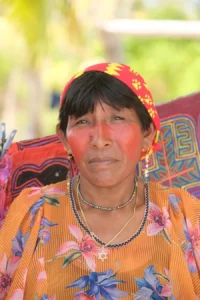
springs are most emblematic craft of the GunaThese are colorful, handmade textiles that are part of women's traditional clothing and represent the community's cultural identity.
Materials used in the making of molas
✔️ Cotton fabrics bright colors
✔️ High-strength threads for embroidery.
✔️ Fine scissors and needles for cuts and seams.
✔️ Natural dyes (although commercially dyed fabrics are also used today).
Technique for making molas
The technique used to make molas is called reverse appliqué and consists of:
1️⃣ Overlaying fabric layers of different colors.
2️⃣ Precise cuts in each layer, revealing the lower colors to form figures.
3️⃣ Hand embroidery of the contours with fine stitches.
4️⃣ Added miniature details, creating highly complex designs.
Each mola can take weeks or even months to complete, depending on the level of detail and skill of the craftswoman.
Cultural significance of molas
✔️ They represent elements of the nature, mythology and everyday life.
✔️ Each design is unique and reflects the artisan's creativity and vision.
✔️ They are a symbol of cultural resistance, since its use has been maintained despite external influence.
Nowadays, molas are also sold as paintings, bags, clothing and accessories, being one of the main sources of income for the community.
2. Natural fiber fabrics and baskets
The art of weaving is another of the oldest traditions of the Guna. Women make baskets, bags and mats with techniques passed down from generation to generation.
Used materials
✔️ Palm and reed fibers, collected on the continent.
✔️ Natural dyes extracted from roots, leaves and fruits.
✔️ Waxes and resins to give strength and durability to the fabrics.
Preparation technique
1️⃣ Selection and drying of natural fibers.
2️⃣ Spiral or interlaced fabric, forming geometric patterns.
3️⃣ Application of natural dyes, obtaining vibrant colors.
4️⃣ Reinforcement with waxes and resins, for greater durability.
These baskets and bags are not only used in everyday life to store food and objects, but they also have ceremonial value in traditional rituals.
3. Beaded jewelry and accessories
Guna women make necklaces, bracelets and anklets with small seed beads, forming complex geometric patterns.
Used materials
✔️ Glass or plastic seed beads.
✔️ Cotton or nylon threads high resistance.
✔️ Fine needles and scissors for threading.
Preparation technique
1️⃣ Creating geometric patterns, which symbolize natural or spiritual elements.
2️⃣ Stringing the beads one by one, forming contrasting shapes and colors.
3️⃣ Tying and closing the piece, ensuring its durability.
These accessories are used by both women and men and they have a spiritual meaning, in addition to being decorative elements.
4. Kuna Yala wood carved masks and figures
Some Guna communities, especially those that still maintain contact with the jungle, make ceremonial masks and wooden carved figures, used in rituals and festivities.
Used materials
✔️ Mahogany and balsa wood, easy to carve.
✔️ Natural paints, extracted from minerals and plants.
✔️ Vegetal fibers for decorative details.
Preparation technique
1️⃣ Selecting the wood and cutting it into blocks.
2️⃣ Detailed carving with knives and chisels.
3️⃣ Polishing and application of natural paints.
4️⃣ Drying and sealing, for greater durability.
Masks are used in spiritual rituals and traditional dances, and some have become collector's items for tourists.
5. The impact of trade and tourism on Guna crafts
Benefits of artisanal trade
✔️ income generation for families, allowing economic self-sufficiency.
✔️ Promotion of Guna culture At national and international level.
✔️ Revaluation of indigenous art, ensuring its continuity.
Challenges and risks
❌ Exploitation of Guna art by external companies, which reproduce the molas without benefiting the artisans.
❌ Loss of authenticity in some pieces, due to the demand for faster and cheaper products.
❌ Competition with industrial products, which imitate traditional crafts without the same cultural value.
To avoid these problems, the Guna communities have implemented artisan cooperatives and regulations to protect their art and ensure that benefits go directly to the creators.
Conclusion: Guna craftsmanship as a symbol of identity and resistance
Guna crafts are much more than simple decorative objects. They represent history, worldview and spirit of resistance of a people who have managed to preserve their traditions over the centuries.
✔️ The molas tell ancestral stories through their unique designs.
✔️ Weaving fibers and beads keeps indigenous techniques alive.
✔️ The wooden masks and figures reflect their connection to the spiritual world.
Despite the challenges of the modern world, craftsmanship remains a fundamental pillar of the Guna identity, ensuring that his legacy endures over time.
Education: isolation vs. acculturation through tourism
Education in the Guna Yala region has historically been a cultural preservation tool, but in recent decades it has become a battleground between the desire to maintain autonomy and the need to adapt to the modern world.
El contact with Western education has brought both benefits and challenges. On the one hand, it has allowed Guna youth to access knowledge and opportunities outside the region. But on the other hand, it has generated a progressive loss of the Dulegaya language, a clash with traditional values and the risk of new generations losing their cultural identity.
Tourism has added another key factor to this dilemma. As more visitors arrive in San Blas, young Guna people come into contact with Spanish, English, and new customs, accelerating the acculturation process.
Next, we will explore the evolution of education in Guna Yala, the challenges it faces, and the efforts to maintain a balance between preservation of identity and integration in the modern world.
1. Traditional Guna education: before the arrival of the school system
Before the introduction of Western education, teaching in the Guna community was based on an oral and community model, in which knowledge was transmitted through elders, leaders and observation of everyday life.
✔️ The elders and the sailas were the main educators, responsible for teaching history, values and mythology.
✔️ The learning was practical, based on fishing, navigation, agriculture and the making of handicrafts.
✔️ Children learned the Dulegaya language from birth., reinforced through songs and mythical stories.
✔️ There were no schools as such, but rather knowledge was acquired collectively and throughout life.
This educational system allowed preserve cultural identity and ensured that each generation understood its role within the community.
2. The arrival of the Panamanian educational system: conflict and resistance
With the consolidation of the Panamanian State in the 20th century, the government attempted impose the national education system in Guna Yala, which generated tensions with the community.
Main conflicts with Western education
❌ Imposition of Spanish as the language of instruction: Most classes were taught in Spanish, which weakened the use of Dulegaya.
❌ Curriculum disconnected from Guna culture: The school curriculum did not include indigenous history or values.
❌ Attempts to eliminate traditions: At times, teachers prohibited children from wearing traditional clothing or participating in spiritual rituals.
❌ Centralization of the system: Education in Panama City was designed without considering the needs of the community.
Faced with these threats, the Guna leaders actively resisted. In the 70s and 80s, they managed to establish a model of bilingual and intercultural educationIn which Spanish and Dulegaya were taught together and content on the Guna worldview was included in the school curriculum.
3. The Dulegaya language crisis: a challenge for Guna education
One of the biggest problems facing education in the region is the progressive loss of the Dulegaya language, due to the influence of Spanish and tourism.
(I.e. Alarming data: According to recent studies, only 60% of Guna children speak Dulegaya fluently, and in some communities more exposed to tourism, the figure is less than 50%.
Causes of language loss
❌ Predominance of Spanish in education and the media.
❌ Interaction with tourists and foreign visitors, who introduce English and other languages.
❌ Migration of Guna families to Panama City, where Dulegaya is not spoken.
To address this problem, programs have been implemented language revitalization, promoting:
✔️ Bilingual textbooks that combine Spanish and Dulegaya.
✔️ Training of indigenous teachers to strengthen teaching in their native language.
✔️ Use of community radio in Dulegaya to reinforce exposure to the language.
4. Tourism and its impact on the education of Guna youth
The growth of tourism in San Blas has brought about a change in the way Guna youth view education and their future.
Positive aspects of tourism in education
✔️ Greater access to foreign languages, especially English, which opens up job opportunities for them.
✔️ Cultural exchange with visitors from all over the world, encouraging the learning of new skills.
✔️ New employment options in the tourism sector, reducing dependence on fishing and agriculture.
Risks of acculturation through tourism
❌ School dropoutSome young people leave school to work in tourism.
❌ Loss of identityForeign influence has led some young people to reject their culture.
❌ Devaluation of traditional knowledgeEducation based on oral tradition and Guna customs is losing relevance compared to Western education.
Some Guna leaders have expressed concern that The new generations value money more than their cultural heritage, weakening the transmission of ancestral values.
5. Strategies for an education that preserves the Guna identity
To balance modern education with cultural preservation, Guna communities have implemented innovative strategies.
📌 Creation of community schools that combine the Panamanian curriculum with the teaching of Guna history and traditions.
📌 Bilingual intercultural education, where the use of Dulegaya is reinforced in the first years of schooling.
📌 Training programs for young people, teaching about responsible tourism and respect for one's own culture.
📌 Use of digital technologies, with platforms in Dulegaya for interactive learning.
These initiatives seek to ensure that education is not a tool for assimilation, but rather a means to strengthen Guna identity in the 21st century.
Conclusion: the challenge of educating without losing identity
The education system in Guna Yala faces a crossroads: maintain cultural autonomy or adapt to the globalized world.
✔️ Education has given young people access to more opportunities, but it has put their language and traditions at risk.
✔️ Tourism has brought economic benefits, but it has also accelerated acculturation.
✔️ Current strategies seek to create a An educational model that preserves the Guna identity without isolating the community from the modern world..
The future of education in the region will depend on how to balance traditional knowledge with the demands of the 21st century, ensuring that the Guna identity remains alive in future generations.
Conclusion: The future of the Guna Yala in a changing world
The Guna Yala, an indigenous people of the Panamanian Caribbean, have maintained their identity and autonomy throughout the centuries, but face modern challenges. Their history is marked by resilience, with a worldview rooted in nature and a vibrant culture expressed in their crafts and governance.
Their social and political structure is based on community democracy, with the Guna General Congress as the highest authority and the sailas as local leaders. The Guna worldview is rooted in nature, with creation myths and an important role for the neles (shamans). Molas, weavings, and handicrafts are expressions of their cultural identity and a source of income. Modern challenges include education, tourism, and climate change, but the Guna Yala continue to preserve their culture and autonomy.